
Aigues-Mortes Loses Its Heir — and Leaves Questions About What Happened Behind the Palace Doors
Prince Emanuel says family and professional obligations led him to renounce the succession. But a carefully worded reference to disagreements over the heir’s role leaves a quieter question hanging over the principality: was this simply a personal decision, or the conclusion of a dispute that could not be reconciled?

Prince Emanuel de Dovimaldi-Nassor renounced his position as Hereditary Prince of Aigues-Mortes on Aug. 19, 2026, ending a succession arrangement overwhelmingly endorsed by the principality’s citizens only two years ago and reopening a question its monarchy had appeared to settle for the foreseeable future.
The immediate explanation is straightforward. Prince Emanuel plans to marry next year and wants to devote sufficient time to his future wife, Marie, and the family they hope to build. His professional obligations have also grown, he says, making it impossible to guarantee the sustained presence and involvement expected of someone who could eventually become sovereign.
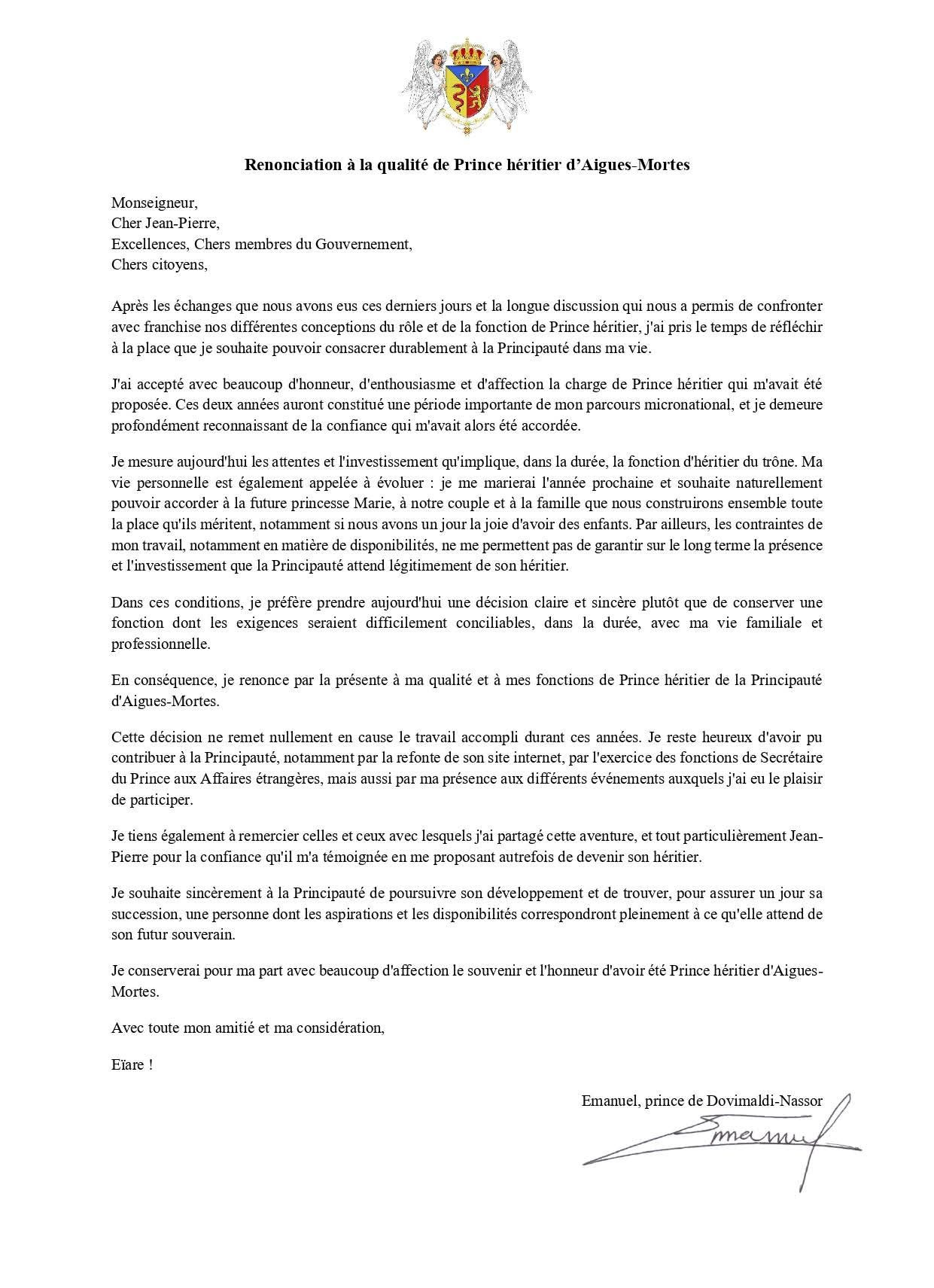
But before citing marriage and professional responsibilities, Emanuel says his decision followed several days of exchanges and a “long discussion” over differing conceptions of the role and function of the Hereditary Prince — a carefully placed reference that leaves unclear how much the disagreement contributed to his departure.
No names are given and no accusation is made. The resignation explains clearly why Emanuel believes he can no longer remain heir. It is considerably less explicit about what happened immediately before he reached that conclusion.
A succession that appeared secure
The suddenness is particularly notable because Prince Emanuel’s accession as heir had been unusually decisive.
Prince Jean-Pierre IV announced Emanuel as his preferred successor in May, 2024. The designation was subsequently submitted to Aigues-Mortes’ General Assembly, where it received an extraordinary 97 per cent of the vote, with turnout exceeding 70 per cent — the sort of near-unanimous result more readily associated with North Korean electoral proclamations than with a genuinely contested referendum.
The vote transformed Emanuel, then sovereign of the Principality of Beremagne, into Crown Prince Jean-Emanuel of Aigues-Mortes and Duke of Bérémagne. Whatever the peculiar optics of the result, there could be little doubt that his designation enjoyed overwhelming formal support within the principality.
Beremagne subsequently ceased to operate as a separate micronational entity following its integration into Aigues-Mortes in August, 2024. Its former sovereign had effectively exchanged the exercise of his own crown for the prospect of eventually succeeding Jean-Pierre IV.
For Aigues-Mortes, Emanuel offered something difficult to manufacture through ceremony alone: a young successor who already had experience administering a micronational government, conducting foreign relations and participating in the wider community.
His resignation does not suggest that his affection for the principality disappeared. He recalls accepting the succession with honour and enthusiasm and points to his redesign of the principality’s website, his service as Secretary to the Prince for Foreign Affairs and his participation in events. He also thanks those with whom he worked, particularly Jean-Pierre IV for the confidence shown in choosing him as heir.
But those expressions of gratitude do not explain why discussions about the definition of his office immediately preceded his resignation.
What was expected of the heir?
That is the central uncertainty left by Emanuel’s statement.
His letter does not merely say that he lacked time. It says recent discussions revealed different conceptions of what the Hereditary Prince should be and do.
Was the heir expected to assume a greater public presence? Were there differences over his participation in government or diplomacy? Did senior figures expect more continuous involvement in the principality’s activities? Or did Emanuel understand the position principally as a constitutional succession role whose practical demands before accession should remain comparatively limited?
The statement provides no answer.
There is no public evidence of a broader rupture within Aigues-Mortes, but neither can the episode be reduced entirely to scheduling: Emanuel himself chose to place the disagreement over his office at the beginning of his explanation.
What can be established is narrower. A disagreement existed, it prompted a lengthy discussion, and the resignation followed. Whether that discussion caused the departure or merely crystallized doubts Emanuel already had remains unclear.
The uncertainty is amplified by the scale of Aigues-Mortes. Like most micronational governments, it depends on a small circle in which ceremonial, administrative and diplomatic responsibilities overlap, making personal relationships unusually important to institutional stability — and disagreements correspondingly difficult to compartmentalize.
That is particularly true in an institution shaped over the years by a handful of longstanding and sometimes forceful personalities, among them former chancellor and current chamberlain Olivier de Constance.
Prince Emanuel does not identify anyone involved in the discussions that preceded his departure. Instead, his letter redirects attention away from disagreement and toward responsibility.
He does not argue that Aigues-Mortes expected too much from him. On the contrary, he acknowledges that the principality is entitled to expect substantial commitment from its heir and says simply that he can no longer guarantee it.
It is an elegant formulation because it permits both sides to be right.
The unresolved legacy of Beremagne
The resignation also leaves a less straightforward question concerning Emanuel’s former principality.
Bérémagne had been closely connected to his elevation in Aigues-Mortes. Founded by Emanuel in 2018, it developed from an absolute into a constitutional monarchy before its eventual integration into Aigues-Mortes.
His departure could therefore have provided an obvious opportunity to reclaim the political identity he relinquished in 2024.
Yet he does not take it. The statement neither restores Beremagne nor claims a resumption of its effective leadership or former sovereign authority. Most strikingly, Emanuel signs simply as “Emanuel, Prince de Dovimaldi-Nassor,” rather than Prince of Beremagne.
The choice leaves unresolved an ambiguity already present in public micronational records. Beremagne is generally described as having ceased to exist separately following the 2024 integration, while other dynastic references have continued to associate its princely dignity with Emanuel.
His resignation settles none of that. Instead, Emanuel appears to withdraw from one succession without using the occasion to reconstruct another.
The timing gives that silence added significance.
Only days before Emanuel’s Aug. 19 renunciation, Saint-Castin established a Provisional Administration in Marsimède, covering territory in Quebec historically associated with the eastern portion of the former Principality of Bérémagne. The measure renewed attention to Bérémagne’s territorial inheritance at precisely the moment when its former sovereign’s position within Aigues-Mortes was approaching its end.
There is no evidence linking the Marsimède decision to Emanuel’s resignation, and his statement makes no reference to territorial questions. The chronology is nonetheless striking: within days, an external question emerged around territory associated with the political project he once governed while, inside Aigues-Mortes, discussions were taking place over what was expected of him as its future sovereign.
Then, on Aug. 19, came the resignation.
Coincidence may be the entire explanation. But the convergence has made several assumptions inherited from Bérémagne’s 2024 integration less certain than they appeared only weeks ago.
A difficult moment for Aigues-Mortes
The succession question returns as Aigues-Mortes prepares for one of the most visible international undertakings in its history.
The principality is due to host MicroCon Europe in 2027, placing it at the centre of a major gathering of micronational representatives. Hosting the event promises considerable visibility and prestige, but also requires organization, money, diplomacy and sustained involvement from a government whose human resources are necessarily limited.
In that context, Emanuel’s references to availability take on broader significance. His departure comes at a moment when the demands placed on senior members of Aigues-Mortes are unlikely to diminish.
The principality may therefore face a more complicated succession search than it did in 2024.
It does not simply need someone willing to accept a title. Emanuel’s letter suggests it needs someone prepared to accept a conception of the office — and a level of involvement — on which the principal actors agree from the beginning.
That distinction may prove important.
Emanuel was not merely a prospective monarch selected from within Aigues-Mortes. His appointment also served as the bridge through which the former Beremagne was incorporated into a larger political project. His departure separates two questions that had been intertwined since 2024: who succeeds Jean-Pierre IV, and what remains of Beremagne’s institutional inheritance.
The answers need not be the same.
A remarkably careful farewell
Perhaps the most revealing feature of Emanuel’s Aug. 19 resignation is its restraint.
He does not present himself as the victim of an internal conflict. He does not criticize Jean-Pierre IV or the principality. He does not claim that the expectations placed upon him were unreasonable. Nor does he use his departure to resurrect Bérémagne.
That may simply reflect an amicable departure handled with considerable discretion.
It may also reflect a conscious decision by those involved to prevent a disagreement from becoming a public dispute.
There is, at this stage, no evidence that Aigues-Mortes is experiencing a wider institutional crisis. Prince Jean-Pierre IV remains sovereign, the government continues to function and preparations for MicroCon Europe 2027 remain ahead.
But the resignation has exposed something less dramatic and perhaps more consequential: two years after choosing an heir with overwhelming public support, the principality discovered that there was not necessarily the same consensus over what being that heir actually meant.
Near the end of his letter, Emanuel expresses the hope that Aigues-Mortes will eventually find someone whose aspirations and availability correspond fully with what the principality expects from its future sovereign.
The sentence can be read simply as a gracious wish for his successor.
It can also be read as the quietest explanation in the document.
Aigues-Mortes must now find another heir.
Before it does, it may first have to decide exactly what it expects that heir to be.


